The State of Texas has become as synonymous with crippling public school debt as it is with oil wells and tumbleweeds.
Its public schools have $148.3 billion in bond debt – the most of any state by far – that will eventually have to be repaid, along with an additional $88.3 billion in interest. For every dollar of borrowed money public schools use to improve education, they must give 59 cents to outside creditors, including large institutions such as Wells Fargo and State Farm, as well as hedge funds.
This costly debt burden, which is lining the pockets of investors with money that could be going to teachers and students, is the result of a convoluted school funding system that makes Texas an outlier nationwide.
Decades ago, to keep state taxes low and funding for education in check, legislators handed more of the financial responsibility for education to school districts that depend on local property taxes. Districts, in turn, began dipping into the bond market for help. But what started as a way to renovate aging buildings and security systems morphed over the years into a borrowing frenzy, with some districts constructing fancy campuses and athletic facilities.
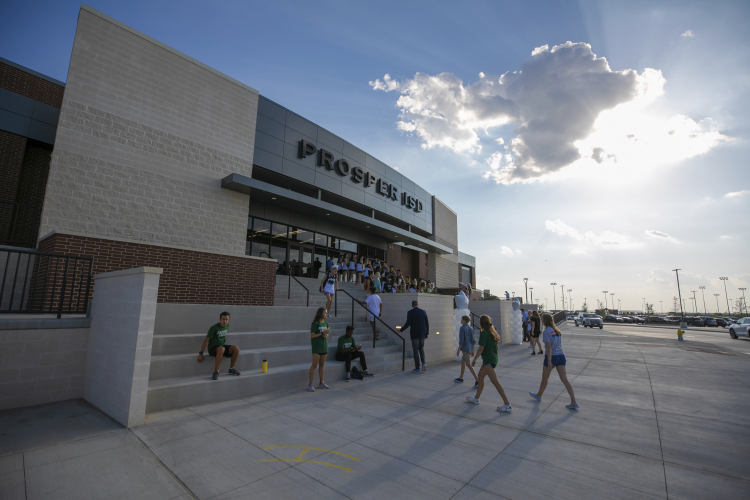
Today, the debt burdens for mid-sized school districts in Texas rival those of major U.S. cities. Most Americans have likely never heard of the Prosper Independent School District, but it has $2.4 billion of debt, nearly as much as the city governments of Baltimore or Detroit. It will need to repay its loans with $1.8 billion of interest. Together, that’s $126,952 per student.
Prosper “has facilities for middle schoolers that look like they belong on a William & Mary campus or a very elite and fancy private school,” said Mandy Drogin, a senior fellow at the conservative Texas Public Policy Foundation. The facilities include a 12,000-seat football stadium with a two-story press box and 24 concession stands, and a cafeteria with dozens of fast-food options like Pizza Hut, Subway, and Chick-fil-A.
The Texas funding model has produced a school system that pours a lot of bond funding into extravagant facilities but not a lot of tax money into education – it ranks 36th nationally in per-pupil funding. The approach certainly hasn’t helped student performance. Test scores have plummeted as bond debt has climbed: In 1998, Texas fourth graders ranked 16th in reading scores, and eighth graders ranked 18th on the National Assessment of Educational Progress, the best national measure of performance. By 2024, fourth graders had sunk to 37th and eighth graders had dropped to 44th.
“[L]arge-scale bonds can create long-term financial burdens for taxpayers without guaranteeing measurable improvements in educational outcomes,” according to Texas Policy Research, a nonpartisan group.
Robin Hood Plan
The debt burden has its roots in the 1989 court case Edgewood ISD v. Kirby. At the time, rural districts, with low property values and thus low tax revenues, were struggling to find the funds to keep schools operating. The Texas Supreme Court ruled that the disparity in funding between rich and poor districts was discriminatory and violated the state constitution’s guarantee of “an efficient system of public free schools.”
In response, the state created a system known as recapture – later dubbed the Robin Hood plan – to redistribute funding among its 1,207 districts.
The state allows each district to keep only a certain amount of property tax revenue per student. Anything more is deemed "excess" and gets recaptured. Districts can’t simply lower their property tax rates to avoid having excess revenue because the state withholds other funding it provides to cities that try to lower their school taxes below a certain mandated amount.

Instead of the Robin Hood plan, Texas could have increased state taxes to bolster rural schools – but that was never a realistic option amid Texas’ shift to a Republican stronghold during the 1990s. When then-Lt. Gov. Bob Bullock merely raised the possibility of creating a state income tax, lawmakers amended the Texas Constitution to make it nearly impossible. Voters quickly turned against Bullock and Democratic Gov. Ann Richards. She lost reelection in 1994 to George W. Bush, who vowed there would be “no new taxes.”
The recapture plan worked at first. Only 34 school districts were determined to have had excess revenue when the system began in 1994, and none had to surrender more than $35 million. Rural districts got a funding boost, and wealthier district budgets remained mostly intact.
But as property values rose in major Texas cities, so did tax revenue, and the state identified more districts each year that had excess money. The legislature’s decision to fix and freeze the maximum per-pupil spending at $6,215, ignoring inflation, put more districts over the line. Last year, the state ordered a quarter of public school districts, 225 in all, to share their revenue. Four were required to give up more than $100 million each.
The Austin Independent School District has borne the brunt of the byzantine funding system.
It lost $772 million of its $1.6 billion budget to recapture last year – more than the next five school districts combined. That left the district with a $90 million deficit, forcing the city to raise property taxes and close 10 of its schools this year to try to balance the budget.
Last year, the state finally stepped in to address the problem. It passed a one-time $8.5 billion funding increase, but some districts said it was not enough to close budget gaps and that it ignored salaries for support staff.
“To keep up with inflation, we needed closer to $19 billion,” said Bob Popinski, dean of policy at the public education advocacy group Raise Your Hand Texas. “A lot of [schools] are adopting budget deficits right now because they still have to run a day-to-day operation. It’s not just the teacher, but the bus driver that gets the kids to and from school, the cafeteria worker that’s making sure breakfast and lunch is ready.”
Debt Fuels ‘Grandiose Ideas’
Districts with deficits like Austin have had the option to cut spending or raise taxes, but they have increasingly turned to the bond market to save them. Bonds are appealing because they are not subject to recapture, and while they must be used on capital projects like renovating aging buildings, the funding can free up other monies for educational purposes.
In 1989, before the Edgewood case, Texas schools held $7.5 billion of bond debt. By 2019, that number had reached $87.8 billion, plus $50.2 billion of interest. Inflation and population growth alone cannot explain the more than 1,000% increase.
Between 2019 and 2025, the debt load increased at its fastest rate in years, jumping by 72%. The Dallas Independent School District alone increased its debt from $4 billion to $7.2 billion, which is $54,497 per student.
No other state is so reliant on bonds. Merritt Research Services previously estimated that roughly 4,000 U.S. school districts, or about a third of the total, have bond debt. Texas has 917 of them. They will owe investors almost $18,000 in interest per student, according to data from the Texas Bond Review Board and Texas Education Agency – and that number will grow as they issue more bonds.
Architecture and construction firms have played a role in pushing bonds onto districts. They have sold “grandiose ideas” to the school districts of building “incredibly beautiful, ostentatious and oftentimes unnecessary facilities,” said Drogin at the Policy Foundation. Since 2021, Texas voters have approved 944 school bond proposals and rejected 542. Seventeen of the 18 most expensive were approved.

Drogin says the state already provides enough money for schools to get by without issuing bonds. “There’s plenty of money in the system,” she said. “It’s being misspent. It just seems that lots of districts are finding ways to spend money on everything other than paying high-quality, well-prepared teachers.”
Certain expenditures have made for flashy headlines. The La Joya district spent $20 million on a school-owned water park in 2018, using money it received from wealthier districts. In 2024, the district laid off 175 employees to help close a budget deficit of exactly $20 million.
The Crowley district in Fort Worth, which has $2.7 billion of debt, including interest, recently announced plans to build a $150 million track and field arena that will also serve as a 5,000-seat concert venue.
For every questionable bond expense, there’s another that fills a genuine need. The Frisco district near Dallas was so overcrowded that kids were learning in portable classrooms, so the district borrowed $691 million to build three new schools.
Sometimes those important projects are on the same ballot as less necessary proposals. A $313 million bond package issued by the New Braunfels district in 2024 will fund a 7,000-seat sports stadium, but it will also pay to replace broken fire alarms.
There is no limit on how much money schools can borrow, so long as voters approve it. The state essentially encourages borrowing by guaranteeing the bonds of districts whose huge debt burdens might scare away investors.
Nearly every Texas school bond carries a perfect AAA rating because they are backed by the state’s Permanent School Fund, a $60 billion endowment of state-owned land. That helps districts like Prosper, whose bonds would ordinarily receive a lower AA- grade and higher interest payments.
In 2023, the Permanent School Fund had guaranteed so many bonds that it reached the legal limit set by the Internal Revenue Service. But the Texas Board of Education and U.S. representative Lloyd Doggett persuaded the IRS to change its interpretation of the law, and today the cap is much higher.
Falling Student Achievement
Texas’ unorthodox funding system would be more justifiable if it had fulfilled the Edgewood ruling’s goal of making education more equitable. But that is not the case.
In 1992, before recapture began, 42% of economically disadvantaged third graders met minimum expectations for reading and math on state standardized tests, compared to 66% of non-economically disadvantaged third graders – a gap of 24 percentage points. In 2025, the gap was 28 percentage points, according to data from the Texas Education Agency.
In an attempt to improve student performance, Gov. Greg Abbott has focused his attention on expanding private school choice, in which families are given tax dollars to attend private schools. Nationwide, private school choice has given families more educational options but hasn’t led to an overall improvement in performance. Meanwhile, the state’s share of per-pupil spending for public schools has not meaningfully increased for seven years.
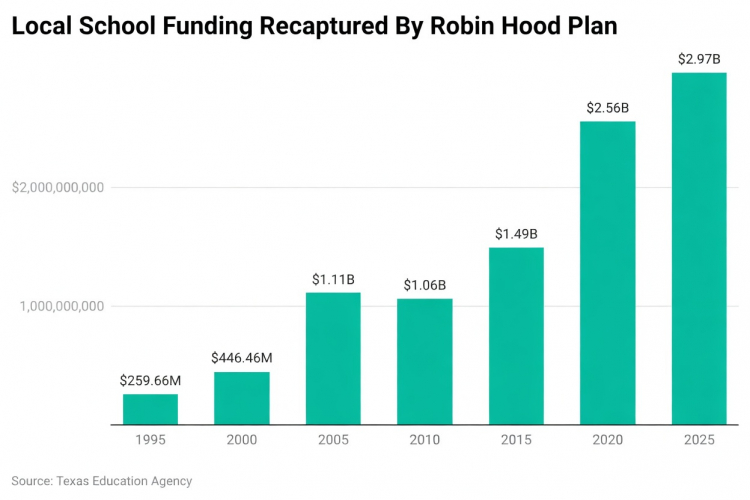
For the moment, the Robin Hood system seems here to stay. Several lawmakers have introduced bills to eliminate or reduce recapture payments, but they don’t gain traction because they would likely force the state to increase spending.
There are also plenty of proposals to tweak the funding system. The think tank Texas Policy Research wants the state to consider setting statutory limits on how much debt schools can take on, and for districts to more prominently disclose the tax effects of interest payments. The Center on Municipal Capital Markets recently advocated for reviving two programs from the 1990s, where the state helped schools pay off their bond debt.
Meanwhile, Dallas will soon ask voters to approve the largest school bond in Texas history. It would spend $6.2 billion to renovate buildings and improve security if it passes this May.
The bond will allow businesses to take advantage of taxpayer funds meant for education, policy consultant Lynn Davenport said in an online post. “Bonds are a big business and hundreds of vendors, contractors, construction firms, and technology companies will feed off the trough of massive taxpayer debt.”